38 spinothalamic tract diagram
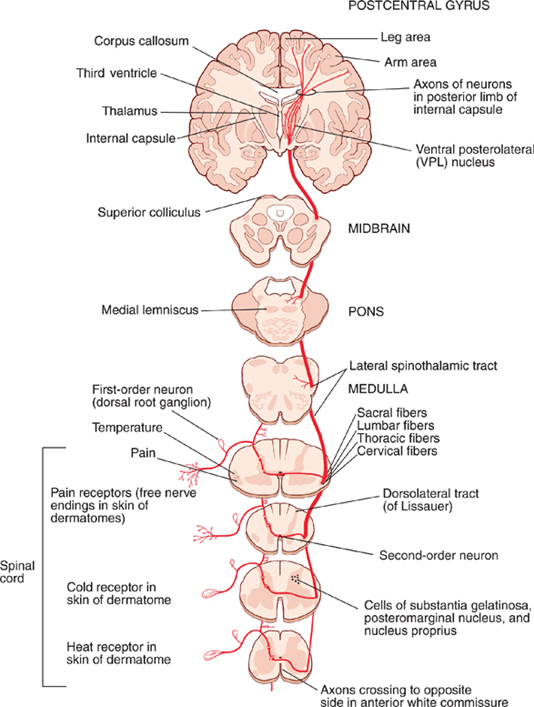
The pathways that carry information about noxious stimuli to the brain, as might be expected for such an important and multifaceted system, are complex. The major pathways are summarized in Figure 10.3, which omits some of the less well understood subsidiary routes. In the spinal cord, it travels through the lateral funiculus of the spinal cord, coursing adjacent to the lateral corticospinal tract. Function. In humans, the rubrospinal tract is one of several major motor control pathways. It is smaller and has fewer axons than the corticospinal tract, suggesting that it is less important in motor control ...
August 19, 2021 - I think it’s time to make a jump, and to look at the nervous networked that feeds the brain information about what’s going on with the body. There are two types of information relays. There are pathways that transmit information that goes from the brain to the limbs (called descending tracks), ...
Spinothalamic tract diagram
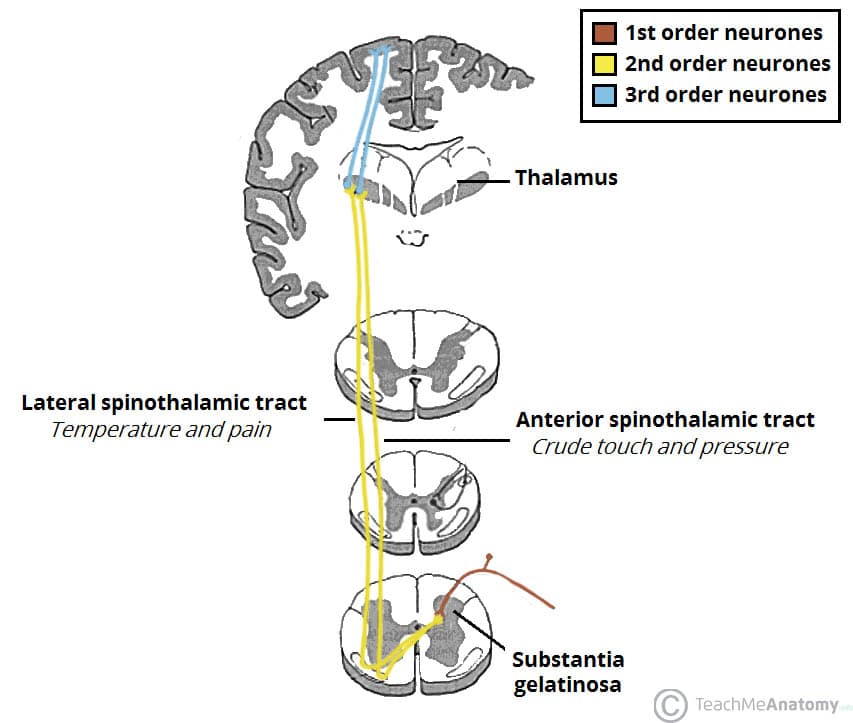
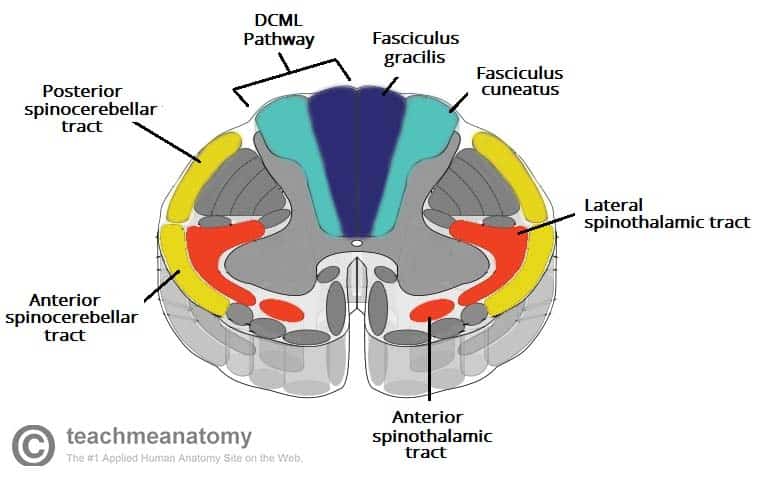
Aug 11, 2021 · The spinothalamic tract (STT) is a sensory tract that carries nociceptive, temperature, crude touch, and pressure from our skin to the somatosensory area of the thalamus. It is responsible for our quick withdraw reaction to a painful stimulus such as touching the stove burner. The spinothalamic tract is composed of two adjacent pathways: anterior and lateral. The anterior spinothalamic tract ... The spinothalamic tract is a sensory pathway originating in the spinal cord that transmits information about pain, temperature, itch and crude touch to the thalamus.The pathway decussates at the level of the spinal cord, rather than in the brainstem like the posterior column-medial lemniscus pathway and corticospinal tract.. The cell bodies of neurons that make up the spinothalamic tract are ... The Anterolateral System. The anterolateral system consists of two separate tracts: Anterior spinothalamic tract - carries the sensory modalities of crude touch and pressure.; Lateral spinothalamic tract - carries the sensory modalities of pain and temperature.; Much like the DCML pathway, both tracts of the anterolateral system have three groups of neurones.
Spinothalamic tract diagram. The spinothalamic tract transmits signals that are important for pain localisation. • The spinoreticular tract: fibres also decussate and ascend the contralateral cord to reach the brainstem reticular formation, before projecting to the thalamus and hypothalamus. There are many further projections to the cortex. A number of cerebral cortical areas are closely involved with the initiation and descending control of voluntary movement. Some cortical areas influence brainstem or spinal cord motor neurons directly or indirectly through interneurons. Other cortical areas influence the activity of "motor ... Dec 21, 2021 · Spinal nerves (diagram) Segmentation of the spinal cord corresponds to the intrauterine period in which the spinal cord occupies the entire vertebral canal. For this reason in adulthood, where the vertebral column is longer than the cord, each spinal cord segment is located higher than its corresponding vertebra. Spinothalamic tract 1. SPINOTHALAMIC SYSTEM 2. Also called anterolateral system, or ventrolateral system. Transmits somatosensory information about pain, temperature, and crude touch. The anterior spinothalamic tract carries information about crude touch. The lateral spinothalamic tract conveys pain and temperature. Consists mainly of group III & IV nerve fibers.
These tracts (fibers) cross over upon entering the spinal cord and ascend to the brainstem centers. The spinothalamic tract, one of the most important pathways of the nervous system, lies anteriolaterally to the ventral horn of the spinal grey matter. This pathway comprises of three neutron sets and forms part of the somatosensory system. Diagram illustrating the route of the ascending transmission pathways and descending pain modulation pathway. ... it is then transferred to the spinothalamic tract which takes it to the thalamus and eventually the somatosensory cortex that perceives pain" is repeated twice. Lateral spinothalamic tract Cutaneous sensory receptors transmit painful and varying thermal stimuli through the dorsal nerve root. The fibers then synapse the dorsal horn of the grey matter. The fibers of the second-order neurons decussate to the contralateral side and ascend in the lateral spinothalamic tract. Soxatotophic organization exist in the tracts of the anterolateral pathway; axons transmitting sensory information from more superior regions of the body ascend wishing t _____ spinothalamic tract, and axons transmitting sensory information from inferior regions of the body ascend within the _____ spinothalamic tract.
The spinothalamic tract also begins with neurons in a dorsal root ganglion. These neurons extend their axons to the dorsal horn, where they synapse with the second neuron in their respective pathway. The name "spinothalamic" comes from this second neuron, which has its cell body in the spinal cord gray matter and connects to the thalamus. ... Marginal zone nucleus or posterior marginalis, is found at all spinal cord levels as a thin layer of column/tract cells (column cells) that caps the tip of the dorsal horn. The axons of its neurons contribute to the lateral spinothalamic tract which relays pain and temperature information to ... lateral spinothalamic tract... anterior spinothalamic tract... anterolateral system... lateral group... medial group... medial corticospinal tract... Sets found in the same folder. Medulla Pyramids Labeling. 11 terms. megan_barnes46 PLUS. Lobes of Cerebellum. 3 terms. megan_barnes46 PLUS. Deep Cerebellar Nuclei. 3 terms. Components. The spinothalamic tract is also known as the ventrolateral system or anterolateral system. It is a sensory tract that transmits information from the skin to the thalamus in the brain.The anterolateral system is composed of: The anterior and lateral spinothalamic tracts.The former helps localize crude touch and pressure, the latter painful or temperature sensation.
Somatosensory System | Neupsy Key
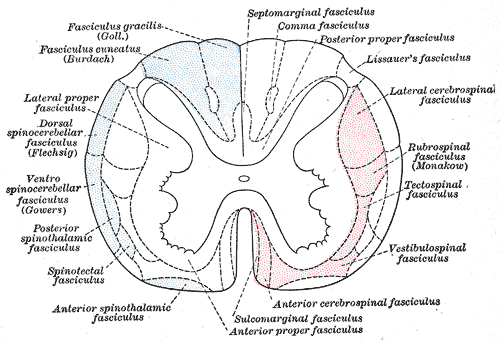
Diagram of the principal fasciculi of the spinal cord. (Anterior spinothalamic fasciculus is labeled at bottom left.) The ventral spinothalamic fasciculus (or anterior spinothalamic tract ) situated in the marginal part of the funiculus and intermingled more or less with the vestibulo-spinal fasciculus , is derived from cells in the posterior ...

Central Processing | Anatomy and Physiology I
The pyramidal tracts include both the corticobulbar tract and the corticospinal tract.These are aggregations of efferent nerve fibers from the upper motor neurons that travel from the cerebral cortex and terminate either in the brainstem (corticobulbar) or spinal cord (corticospinal) and are involved in the control of motor functions of the body.

What is the Spinothalamic Tract? (with pictures)
A few spinothalamic tract neurons are also present in the ventral horn (Kayalioglu et al., 1996, 1999). In cats, spinothalamic tract neurons are located primarily contralaterally in medial laminae 7 and 8, while in monkeys they are found in the contralateral laminae 1 and 4-5, with the rest in laminae 6-8 (Trevino and Carstens, 1975).

Spinal Tract Pathways
November 12, 2016 - The anterior spinothalamic tract, also known as the ventral spinothalamic fasciculus, is an ascending pathway located anteriorly within the spinal cord, primarily responsible for transmitting coarse touch and pressure. The lateral spinothalamic...

Spinothalamic Tract - an overview | ScienceDirect Topics
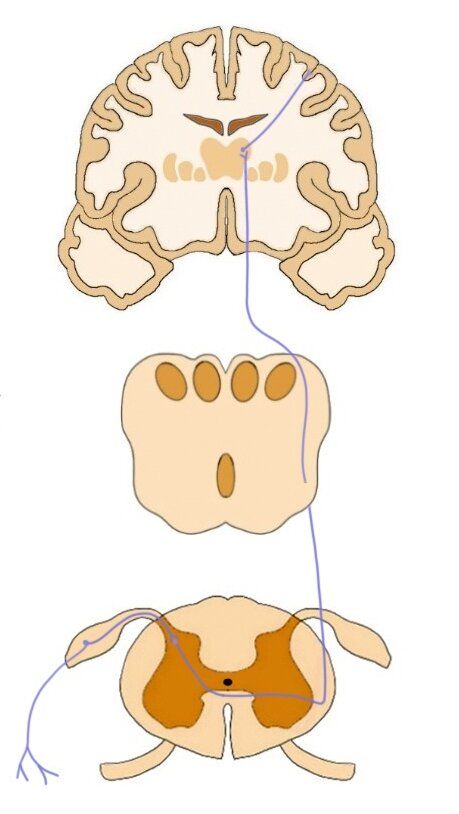
The spinothalamic tract is a sensory pathway originating in the spinal cord. It transmits information to the thalamus about pain, temperature, itch and crude touch. The pathway decussates at the level of the spinal cord, rather than in the brainstem like the posterior column-medial lemniscus pathway and corticospinal tract .
The Spinal Cord
Another major sensory pathway is called the anterolateral system (ALS), also called the spinothalamic tracts (Figure 3, left side). This sensory system carries information about noxious stimuli, temperature stimuli, and deep touch. Axons of the primary sensory neurons that bring information ...

The two main ascending pathways of pain. (A) The ...
5. THE TRIGEMINAL SYSTEM Somatic Sensation of the Face and Head Objectives 1. Outline the two pathways for facial sensation from the head. 2. Contrast facial sensation from the head and somatic sensation from the body. In what ways are they similar? Different? Try drawing this on the Haines atlas diagram at the end of the lecture. 3.

Spinal Cord - Textbook of Clinical Neuroanatomy, 2 ed.
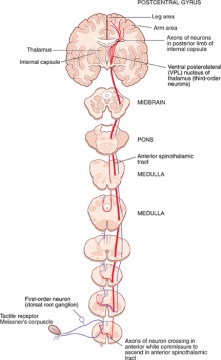
This pathway mediates sensation of pain and temperature. This diagram illustrates the spinothalamic tract (also known as the anterolateral system/ventrolateral system). The spinothalamic tract is one of the ascending sensory tracts which conveys sensory information from the periphery to the central processing systems.

Spino-Olivary Tract - an overview | ScienceDirect Topics
lateral spinothalamic tract and spinoreticular tract. dorsal (posterior) spinocerebellar tract... dorsolateral tract (tract of lissauer)...

Spinothalamic Tract Neurons, Visceral Input | SpringerLink
The spinotectal tract (spinomesencephalic tract, spinotectal fasciculus, spino-quadrigeminal system of Mott) arises in the spinothalamic tract and terminates in the inferior and superior colliculi.. It is situated ventral to the lateral spinothalamic tract, but its fibers are more or less intermingled with it.. In the brainstem the fibers run lateral from the inferior olive, ventro-lateral ...
Patient examination: Neurological evaluation
Dec 17, 2019 · Os odontoideum (plural: ossa odontoidea) is an anatomic variant of the odontoid process of C2 and needs to be differentiated from persistent ossiculum terminale and from a type 2 odontoid fracture. It can be associated with atlantoaxial instabili...
The Ascending Tracts - DCML - Anterolateral - TeachMeAnatomy
The basis of this discussion is highlighted by the importance of remembering the anatomy, and once you recall this simple diagram, the syndromes become significantly easier to recall: The spinothalamic tract is intentionally drawn on the opposite side of the cord, to represent that those nerve fibres crossover in the cord, providing ...
Know Your Brain: Spinothalamic Tract
Spinothalamic Tract This diagram illustrates the spinothalamic tract (also known as the anterolateral system/ventrolateral system). The spinothalamic tract is one of the ascending sensory tracts which conveys sensory information from the periphery to the central processing systems. There are three main ascending (afferent) pathways which convey sensory information:
Neuroanatomy Online: Lab 3 (Æ’5) - Somatosensory ...
Download scientific diagram | Schematic representation of target (lateral spinothalamic tract) and its environs at the C1-C2 level. from publication: CT-Guided Percutaneous Cordotomy for Intractable Pain in What is More than a Disease: Lung Malignancies | Lung cancer is the leading cause of ...
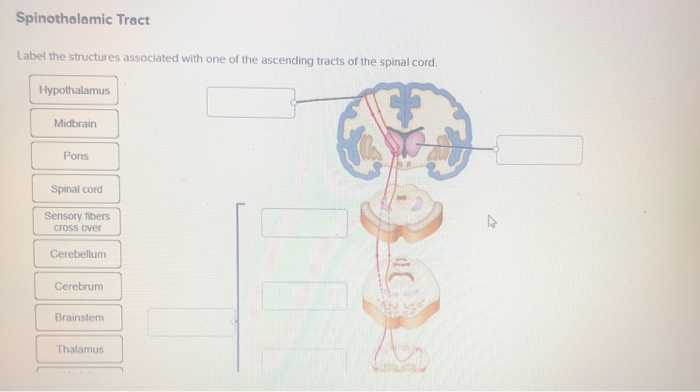
Spinothalamic Tract Label the structures associated | Chegg.com
12 Nov 2016 — The lateral spinothalamic tract, also known as the lateral spinothalamic fasciculus, is an ascending pathway located anterolaterally within ...
Ascending Tracts of spinal cord
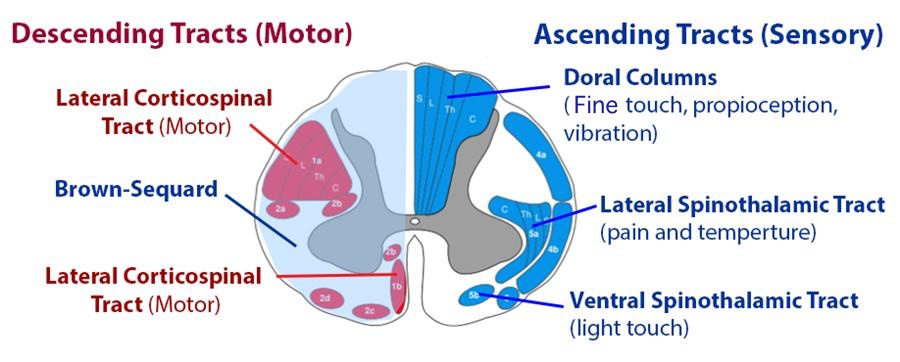
The lateral spinothalamic tract (Figure 2) conveys pain and temperature information, whereas the anterior spinothalamic tract carries information about light touch. These tracts arise from spinal dorsal column neurons, which receive input from afferent fibers entering the dorsolateral fasciculus or Lissauer's tract of the spinal cord.

Spinothalamic Tract - Msrblog
4 Draw labelled diagram to show the origin course and termination of ascending tracts. 4.1 Posterior Column Tract; 4.2 Lateral SpinothalamicTract; 4.3 Spinocerebellar Tracts; 5 What are the characteristic features of descending tracts? 6 Name the important descending tracts and write their functions.
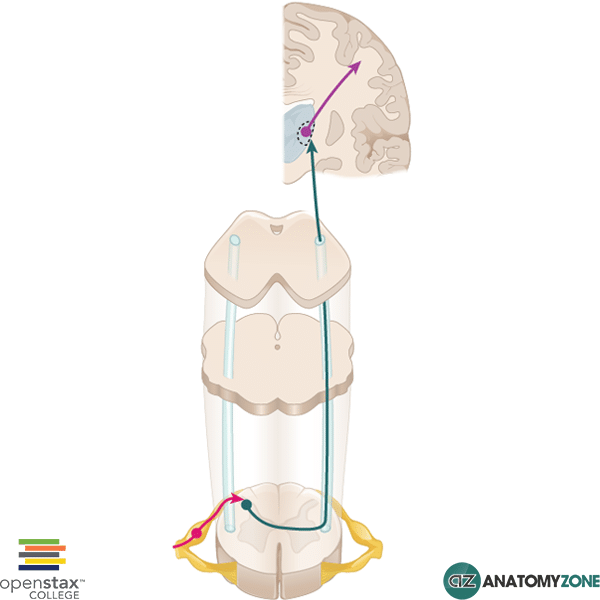
Spinothalamic Tract - AnatomyZone
The spinothalamic tract is a part of the anterolateral system or the ventrolateral system, a sensory pathway to the thalamus.From the ventral posterolateral nucleus in the thalamus, sensory information is relayed upward to the somatosensory cortex of the postcentral gyrus.. The spinothalamic tract consists of two adjacent pathways: anterior and lateral. The anterior spinothalamic tract carries ...
Spinothalamic tract - Wikipedia
spinothalamic tract, and central tegmental tract. This region also contains the trapezoid body, part of the auditory path-way involved in the localization of sound. The medulla oblongata relays information from the spinal cord to the brain and is composed of a ventral portion and a dorsal tegmentum. The ventral part includes the pyramids

Brown-Séquard syndrome - Wikipedia
Spinothalamic tracts are the ascending tracts present in the spinal cord. An ascending tract is a bundle of nerve fibers that carries signals from the peripheral body parts to the higher centers of the brain. As the name indicates, spinothalamic tracts originate in the spinal cord and terminate in the thalamus, which is a part of the forebrain.
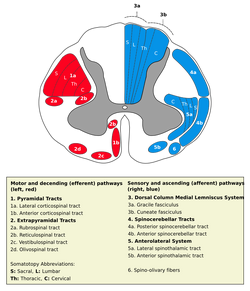
Spinothalamic tracts | Psychology Wiki | Fandom
Anterior Spinothalamic Tract Crude touch and pressure sensations from right side of body The anterior spinothalamic tract carries crude touch and pressure sensations to the primary sensory cortex on the opposite side of the body. The crossover occurs in the spinal cord at the level of entry. Anterior spinothalamic tract Medulla oblongata Midbrain

Spinothalamic Tract - Msrblog
The spinothalamic tract is divided into two major branches. The anterior spinothalamic tract consists of the secondary neurons of the somatosensory system that run upwards into the brain along the spinal cord. The primary neurons receive coarse touch and pressure information from the skin, and these neurons synapse onto second order neurons which have their cell bodies in the dorsal root ganglion.

Dorsal Column-Medial Lemniscal and Spinothalamic Pathway ...
The diagram illustrates the spinothalamic tract pathway as part of the anteriolateral system. Contributed by Campbell University School Of Osteopathic Medicine . ... Spinothalamic and spinohypothalamic tract neurons in the sacral spinal cord of rats. I. Locations of antidromically identified axons in the cervical cord and diencephalon.

Ascending Spinal Tracts | Facts, Types, Functions, Systems ...
tract. The anterolateral pathways consist of three tracts: the spinothalamic, spinoreticular, and spinomesencephalic tracts. The spinothalamic tract is the best known and mediates discriminative aspects of pain and temperature sensation, such as location and intensity of the stimulus. Like the posterior
The Ascending Tracts - DCML - Anterolateral - TeachMeAnatomy
The Anterolateral System. The anterolateral system consists of two separate tracts: Anterior spinothalamic tract - carries the sensory modalities of crude touch and pressure.; Lateral spinothalamic tract - carries the sensory modalities of pain and temperature.; Much like the DCML pathway, both tracts of the anterolateral system have three groups of neurones.

16 Major sensory and motor systems | Spinothalamic tract ...
The spinothalamic tract is a sensory pathway originating in the spinal cord that transmits information about pain, temperature, itch and crude touch to the thalamus.The pathway decussates at the level of the spinal cord, rather than in the brainstem like the posterior column-medial lemniscus pathway and corticospinal tract.. The cell bodies of neurons that make up the spinothalamic tract are ...
Spinothalamic tract - Physiopedia
Aug 11, 2021 · The spinothalamic tract (STT) is a sensory tract that carries nociceptive, temperature, crude touch, and pressure from our skin to the somatosensory area of the thalamus. It is responsible for our quick withdraw reaction to a painful stimulus such as touching the stove burner. The spinothalamic tract is composed of two adjacent pathways: anterior and lateral. The anterior spinothalamic tract ...

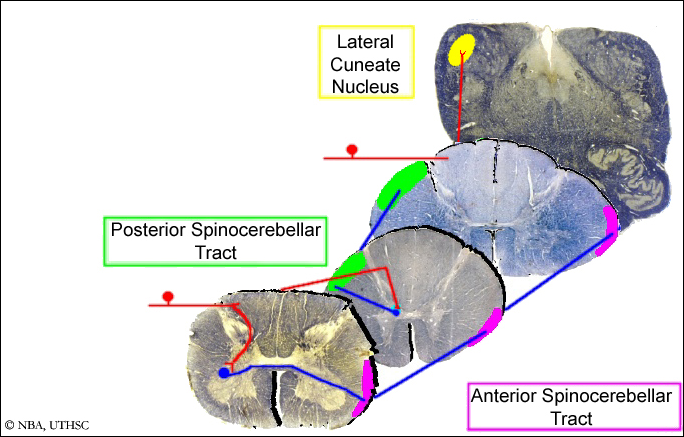
Spinocerebellar tracts - Neuroanatomy Tutorial | Ascending pathways
.jpg)
Major sensory and motor pathways | Deranged Physiology

Major sensory and motor pathways | Deranged Physiology

Duke Neurosciences - Appendix 1: Somatic Sensory Pathways

Spinothalamic tract - Wikipedia
The Spinal Cord
Incomplete Spinal Cord Injuries - Spine - Orthobullets

Lateral spinothalamic tract | Radiology Reference Article ...

Spinotectal tract - Wikipedia

Know your spinal cord – The spinotectal tract | Lunatic ...

Spinal cord tracts and reflexes - Knowledge @ AMBOSS


Comments
Post a Comment